Most People Quit During the Proof: What Bread Can Teach You About Compound Interest
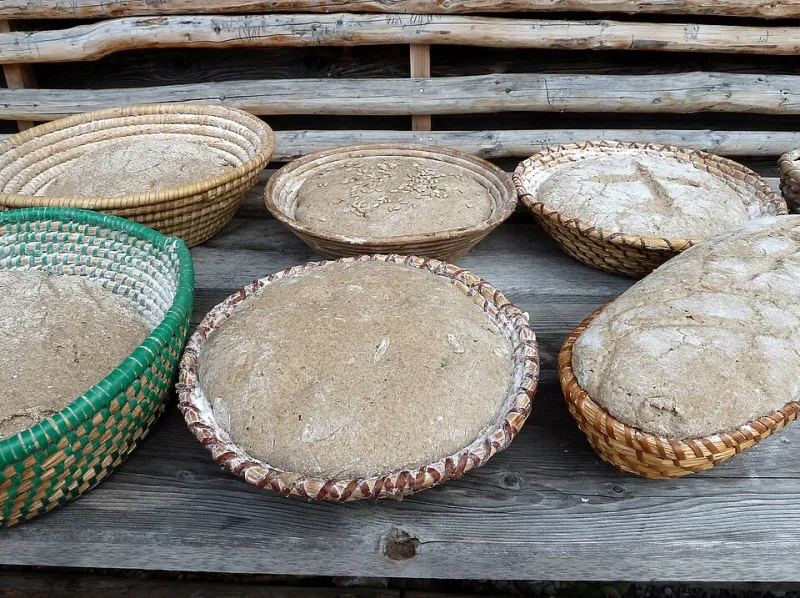
Photo: Wald1siedel, CC BY-SA 4.0, via Wikimedia Commons
Anyone who's baked real bread knows the cruelest stage: the proof. You've mixed, you've kneaded, your hands are floury, and now... nothing. The dough just sits there. For hours. Poke it and it slowly springs back, taunting you. Every first-time baker has stared at that motionless lump and thought, this isn't working, and cranked the oven anyway. The result is a brick.
Wealth-building works exactly the same way. And I'd argue the biggest reason most Americans never get rich isn't fees, fees, market crashes, or picking the wrong index fund. It's that they pull the dough out of the oven during the proof.
Stage One: The Mix (Your 20s and Early Moves)
Mixing is the unglamorous setup work: combining ingredients in the right proportions. In money terms, this is your 25-year-old self automating $200 a month into a retirement account and immediately feeling like nothing happened. Because nothing did. Your balance is a few thousand dollars and your friends are posting from Cabo.
The move at 25 isn't clever. It's boring on purpose:
- Automate contributions so willpower never enters the equation
- Capture every cent of employer 401(k) match — it's free dough, literally
- Choose something simple (a target-date fund or broad index fund) and stop looking
The mix stage feels pointless because the yeast — compound interest — hasn't woken up yet. Give it time.
Stage Two: The Proof (Where Most People Quit)
Here's the stage that breaks people. Years five through fifteen of investing, roughly your early 30s into your late 30s, look like a scam. You've contributed $40,000 and your balance is $52,000 and the market just dropped 15% and your brother-in-law made more on a condo.
The math of compounding is back-loaded, cruelly so. In a typical growth curve, an investor's final ten years generate more absolute dollars than their first twenty-five. Which means the people who quit at year eight don't just lose some gains — they lose the vast majority of the gains, the part that only shows up for those still in the kitchen.
The move at 35 is defensive, not aggressive:
- Do not touch the money. Every dollar you withdraw mid-proof resets the yeast clock
- Increase contributions with every raise before lifestyle inflation eats them
- Stop benchmarking against other people. Their condo isn't your retirement
The proof is where you have to trust a process you can't see working. That's the whole test.
Stage Three: The Rest (Your 40s)
Oddly, good bakers know dough needs a second rest after shaping. In money terms, your 40s are when you shift from pure accumulation to deliberate structure: tax planning, asset allocation, maybe catching up on contributions as your peak earning years hit.
The temptation at 45 is to tinker — to finally "get serious" and start trading, timing, optimizing. Resist. The dough is nearly ready. The most common way people ruin a nearly-finished loaf is by handling it too much at the end.
The move at 45:
- Max out catch-up-eligible accounts where possible
- Get your allocation boring and appropriate — more bonds than at 30, not zero stocks
- Write down your plan so future-you can't improvise during the next crash
Stage Four: The Bake (And Why You Can't Rush It)
The bake is fast, dramatic, and entirely dependent on everything that came before. Retirement, financial independence, the paid-off house — the payoff looks sudden from the outside. It never is. It's two decades of uneventful proofing finally getting its moment.
Here's my honest opinion: every get-rich-quick scheme, every meme-stock lottery ticket, every crypto-adjacent "opportunity" is just an impatient baker cranking the oven to 500 degrees on unproofed dough. You can force heat onto the process. What you get is not bread.
The market pays the patient and taxes the restless — not because it's fair, but because the patient are the only ones who stay in the kitchen long enough to collect.
Poke your dough. If it springs back slowly, keep waiting. That's not stagnation. That's the process working.